Heian Costuming
The Heian Period was a relatively peaceful time in Japanese history. It was a time when the aristocracic culture was at it's hight. First, in order to understand the manner of dress, we have to understand the underlying aesthetic values that were prevalent in that time.
Tyranny of Elegance: The Heian period was a time when the overall appearance of all aspects of life, often referred to as a 'Tyranny of Elegence', dictated not only the dress, but the manner in which you wrote and behaved.
Mono no Aware: 'The nature of things'. This concept was very prevalent, especially in poetry and writing of the Heian era. It is a term often used in the description of nature, especially those aspects of it which are fleeting. Often had connotations with the seasons, such as the falling sakura blossams or the falling snow: those things which were poetically transient.
Nature: Nature and the passage of time was something celebrated not only by festivals and religious practices, but by authorship and clothing. The conseption of the Kasane no Irome was a manner in which dressing in varying colors of layers reflected certain aspects of nature. Usually, these layers were specific to the season, and wearing the wrong combination (or even the wrong color) at the improper time could be disasterous for ones social standing.
Kasane no Irome: The art of layering Kimono (please note: I use the term kimono loosely. Translated directly, it means 'thing to wear', indicating that any garment can fall under the category) in colors to reflect aspects of nature. The art was relative to the wearer and was a source for the judgement of her taste. See more under the side tab.

The above picture is an example of what the ladies of the Heian era would have worn. Prior to the Sumtuary Laws of 1074, which limited the dress of a court lady to 5 layers (not including the underchemise or 'undergarments'), one would have applied as many layers as one possibly was able to. The Empress Tashi is said to have worn as many as 40 uchigi (Lined kimono). The manner of dress was called the Ju ni hitoe or 'twelve hitoe', indicating that typically there were twelve layers.
The Layers
This will show the layers, put on in order from first to last.
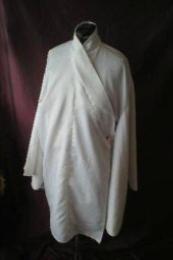 | Kosode This garment was a plain white, knee length garment, cut in a similar style of a modern Kimono. The sleeves, unlike most of the other layers, are sewn shut in front, like most modern Kimono. In the layering effect, the Kosode was supposed to not be part of the color compinations, and was supposed to have minimal influence on the overall effect of the style...
|
Nagabakama Nagabakama were pants worn under the layers. Because they were so full, they are sometimes referred to as 'trowser skirts'. These pants were either scarlet red (for married women) or a deeper maroon-red (for unmarried women). Occasionally white nagabakama were worn, usually for Shinto celebrations such as births/ Nagabakama were longer than modern Hakama, covering the foot and often trailing up to 2 feet behind the wearer. They were usually made of a thick, raw, unbeaten silk, though, according to some sources, they may have been made of linnen. | 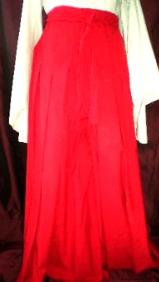 |
 | Hitoe The hitoe was an unlined underkimono that began the colorful combinations seen in the Kasane no Irome. The fabrics used were seasonally dependant, and were typically without any special design or print. There are fewer documentable colors used for Hitoe, but there were general rules of thumb when it came to choosing the color. Empress Tashi's marginalia in Minamoto no Masasuke's book on fashion indicate that if warm tones are used for the uchigi (see below), then one should use a cool tone for the hitoe. and vice versa. |
Uchigi Uchigi were the lined garments that made up most of the colored parts seen in the Kasane no Irome. Unlike the Kosode and most modern Kimono, Both the front parts of the sleeves and the back parts of the sleeves were left open in order to better display the colors. The colors chosen in this display are that of the Green Maple (ao momiji: 青紅葉), and this is one of the few combinations that defy the rule Empress Tashi wrote of (see Hitoe). Being as the first two colored layers are red, perhaps this combination was not the best choice to display the diversity of the layers. The fabrics were usually fine silk, though the kind of silk was seasonally dependant. Uchigi were usually printed and/or woven with varying designs that were also seasonally dependant. These designs, along with the colors and fabrics used, also were restricted to rank or position in court. I have seen documentation of the use of cotton for uchigi, however it would have been very expensive, and would have most likely been imported from India through China. For less formal occasions, dressing would have ended at the Uchigi, however, for more formal occasions, and Uwagi would have been added. Uwagi Uwagi were robes made of finely printed or woven silk they would have been worn over the top of the layered Uchigi. The Uwagi was cut narrower and longer than the Uchigi to give the overall combination a more dressed effect. The picture depicted here is of the layers of the Uchigi with a Uwagi worn over them. |   |
 | Mo The most formal manner of dress was called the karaginu-mo. The Karaginu Mo consisted of a Jacket called a Karaginu (see Below) and a Mo, which is a hand painted train. Typically, the paintings on the mo depicted Bamboo or pine, though arguably, butterflies or sakura branches were also depicted. The Mo was tied around in a bow in front. It would have been pleated at the top and would have had two seperate pieces that would have been sewn into the pleated top and tralied with the rest of the train. The Mo was always white and made of a fine, unpatterned silk. The Mo depicted here is a work in progress, and the only painting on it currently is the red tomoe seen depicted here. |
Karaginu The Karaginu was a jacket that was worn over the top of everything on the most formal of occasions. The patterning and weaving of the silk was the finest of all the garments. The Karaginu was cut in a similar fashion to the Uchigi, however the front panel was left off, ensuring that the jacket would reveal the multitude of color beneath. The teal karaginu in the picture is not made in a period pattern for reasons mentioned in the 'Tips for Reinactors' section of this site. | 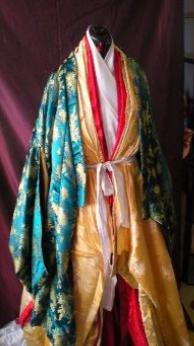 |
