Kasane no Irome
The layers of dress were something that were intended to reflect nature and the overall mood of the day. Each layer was put on with careful planning according you the season, your status, the tone of the event being attended, and the mood reflected by the day. The colors of Heian Japan were strictly scrutinized according to your status. Some colors were restricted according to your rank, hence limiting the number of Kasane sets you could wear.
The color choices listed below are listed in Period documents such as the Nyobu no Shozoku no Iro, a compilation of lists created by the master of court ceremony, Minamoto no Masasuke, for the Emperess Tashi, who found herself in a rather precarious social situation. Emperess Tashi is the only Emperess to have ever ruled under two different Emperors, having been called out of her solace as a Buddhist nun . To prevent her from committing any faux pas through her dress, Masasuke compiled a list of appropriate color combinations for each season as a favor to her.
Please note that Emperess Tashi had a collection of nearly 500 kimono. The average lady had less than 60. The color combinations were up to interpretation: it was ok to alter a color to suit your personality or if you did not have one particular color available, an alternate to complete the set was perfectly appropriate to use. The basis of the Kasane no Irome was to judge a lady on her taste, and often critique of ones outfint was documented. In some rare cases, people were laughed out of court for choosing an inapropriate color or color combination.
Below are listed some of the appropriate color combinations:
Year round celebrations:
Please not that most year round celebrations were intended for special occasions and festivals. Some of these combinations were more suited to specific occasions and times of the year, however, some of these combinations are documented to have been worn for everyday occasions.
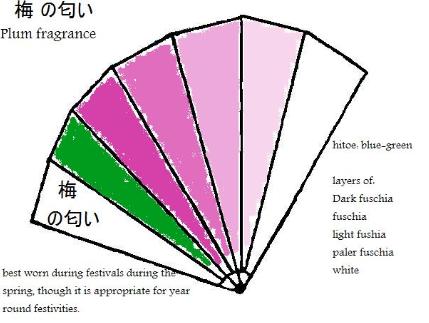
Maroon Fragrance "Suo no nioi" Almost all of the 'nioi' collection were appropriate for year round occasions. | 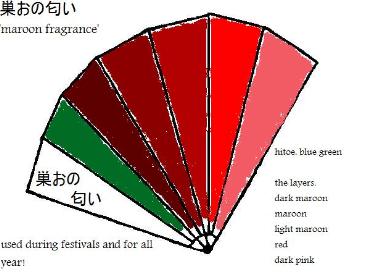 |
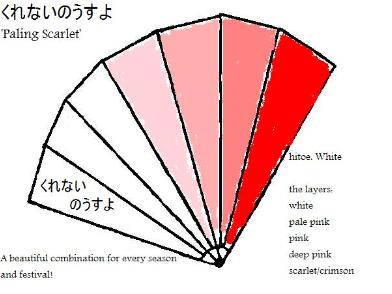 | Paling Scarlet "Kurenai no Usuyo" In Heian language, there is a difference between the term 'pale' and the term 'light' when applied to colors. Light was often deeper in hue and overall darker in color. |
Scarlet Fragrance "Kurenai no Nioi" Another of the Nioi collection. Sometimes another shade of scarlet red was used for good effect.
| 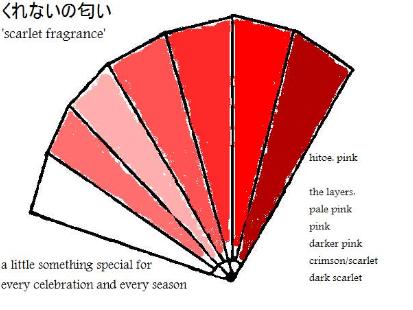 |
 |
 fan.jpg.opt423x318o0,0s423x318.jpg) |
 |
